Telus is my cellular service provider and I recently called them before I went to Europe to ask about the cost of using my BlackBerry while I was traveling. I was told that I would pay $10 per MB for data and based upon my daily usage in Canada, I was able to predict my cost because I wouldn't be using the browser like I might here in Canada. Perhaps I would get about 20 emails per day, and each email might be at most 5K so I might expect to consume 100K per day, or about a dollar per day.
What they don't explain is that every hour I would be billed 20K to maintain the convenience of a real-time data connection. Back in Canada, that connection is maintained for just 1K per hour. So I was billed an extra 450K (24 hours x 19K), or $4.50, per day in unexpected data!! Telus claim that they are billed the 20K from the foreign carrier, but those networks are running modern 3G networks and they would have as advanced billing capabilities as any carrier here and the data usage would be the same. Therefore, the carriers are charging a HUGE premium, perhaps in Europe, but perhaps by agreement between carriers on both sides.
If you want the convenience of having email arrive immediately while you are in Europe, then you are forced to pay $0.20 per hour and it would be advisable to turn off the device when you sleep which I never do here in Canada. Telus may not have told a direct lie, but they do misrepresent the cost of operating their devices outside their network.
Thursday, September 01, 2011


Hubble movies
Normally we think of images made by the Hubble Space Telescope as being static views of galaxies or stars far away. But 14 years of images stitched together into short video clips provide a very interesting view of how stars form. 
Monday, August 08, 2011
Famine is a crime
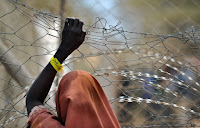
A year ago I was getting ready to go to Malawi and my other blog discusses a few of the complexities of international development that I encountered. Disaster relief efforts, such as the response to the famine in Somalia can be even more complex. For example, it would be simple to imagine a boat load of surplus North American food, perhaps bags of wheat, being shipped to Somalia. But imagine being a farmer near the drought zone seeing his crop value drop as the market is flooded with free imports. Dumping a commodity in Canada would result in a trade dispute, but that dispute mechanism is not easily activated by a rural farmer in east Africa. Hopefully the dollars being directed to help people in Somalia through aid agencies in the developed world will be used to purchase food produced within east Africa so as to stimulate, not crush, their agricultural sector.
Someone recently asked me what I thought was the cause of the famine in Somalia . . . actually ... that isn't true. This person simply stated the cause was too many people. I noted that my great-grandparents lived in a society where big families were the norm and most of the developing world is based upon a similar agricultural economy. My response was perhaps a small education, but it makes me wonder how is it possible for Canadians to get the impression that the famine in Somalia is just an agricultural production problem? It seems to me that the media is explaining there is a long lasting war. But perhaps the difference of circumstance is so far beyond our cultural context that most people are incapable of imagining the situation. I went to a refugee camp when I was in Malawi and I can't truly comprehend what is happening in Somalia.
The Foreign Policy article linked here presents a more complex story of food insecurity routed in political extremism. Just like Stalin starved people to death, so too have extremists conducted a similar campaign in Somalia. Imagine being a logistics officer with Doctors Without Borders and consider what it would be like to negotiate with weapon-toting radicals as you attempt to get food to people who are starving to death. I support a couple organizations that are capable of delivering thoughtful action and I hope you will also give generously -- Doctors Without Borders and CARE
Jay's video

Jay Macmillan is working on a full length video of the Thompson Brigade and his teaser video has some beautiful shots as expected. I am very briefly seen as our crew does a switch on a windy day. The work on my video has begun, slowly.
Sunday, July 17, 2011
Heading home
On Friday, 200 years to the day after David Thompson arrived at the mouth of the Columbia River, we paddled into Astoria Oregon. It was a typical day in terms of distance, about 50 kilometers, and the weather was gracefully calm until the last few kilometers west of Tongue Point into the harbour. The Point is known for big waves generated by the outgoing river current meeting the incoming tides and waves. We had paddled since 7:30am and arriving at the wharf at 2:30pm gave us just 90 minutes to dress and prepare for our final short paddle to the arrival ceremony.
We have done over two dozen arrival ceremonies with audiences numbering just a few or several hundred. We paddle the canoes around in a circle or figure 8 shape and then line up facing shore to greet the people and to request permission to come ashore, sometimes with a black powder gun shot from the North American Land Surveyor boat followed by a second volley from shore. Sometimes we race to the beach and sometimes we proceed in a more orderly fashion. On Friday afternoon the tide was high when we arrived which concealed the old pier pilings in the little bay next to the Marine Museum where we had planned to impress the crowds with our six-week-honed paddling skills.
Pathfinder was the lead boat and was the first to run into a submerged post causing a ripple of confusion into the trailing canoes but the No Way Corveé boat, overflowing with their entire eleven person crew, gave the audience a few seconds of unplanned excitement when they teetered from side to side on a hidden plank before they carefully reversed off their perch.
The mist that began falling when everyone was getting loaded into their boats turned into full rain and before long everyone was soaking wet in their finest arrival costume. Following the welcoming remarks and greetings the Brigade scattered as some went for the comfort of motels while many set up camp in a gymnasium at the local high school. The gym was beside the hallway that hosted the evening's celebration & libation, probably to the disappointment of those sleeping.
On Saturday morning we had a final breakfast and recognition event. There were 51 people who paddled the entire distance and in total, 48% of the paddlers were women which is a substantial increase from the 2008 ratio. Plans are underway for a reunion in November for the video that Jay will produce.
The Brigade wasn't as physically demanding as the 2008 Brigade, but I enjoyed it immensely. There was more time for socializing with other paddlers and the shorter distances meant we weren't as exhausted everyday. Many now wonder when and where will the next big canoe Brigade happen -- perhaps 2017 will deliver a 150th Canadian birthday event.
----------
Sent from my BlackBerry
Monday, July 11, 2011
Camp Birthdays
With a hundred people around, lots of birthdays happen over a six week period. This video is kind of short and shaky and well ... hardly worth posting. But it does represent a very brief glimpse at the collective friendships that come together on the Brigade. Many people have impressive musical talents and in this case nearly everyone gathered on a small island where we are camping in Cascade Falls, Washington and gave Gale her 60th birthday greeting.
----------
Sent from my BlackBerry
----------
Sent from my BlackBerry
Monday, July 04, 2011
Art

Today I was paddling with some others from the Brigade and one of the people makes excellent landscape sketches. The photo shows something he made from memory and I will attempt to remember to photograph it on Tuesday when we return to the place where we finished paddling this morning. It was just over 20 km but we experienced the strongest winds yet on the journey.
----------
Sent from my BlackBerry
Wednesday, June 29, 2011
Vantage Washington -- wind

Today we left Wenatchee late -- 8:30am -- because we had a 10:30 arrival about 17km down river at Rock Island. The morning current pushed us along nicely and we even had a tail wind at time. After an arrival ceremony, some hotdogs and some time spent chatting with visitors, we moved the canoes around the next dam and headed down river again. Soon the current slowed and the wind turned towards us. The canoes split into two groups, each betting that the opposite shore would be the easier. Our group was in the shade for much of the hot afternoon hours and we even saw a few groups of wild sheep perched on the canyon-like walls. It is very beautiful along this section of the Columbia.
----------
Sent from my BlackBerry
Tuesday, June 28, 2011
Who planned this thing?

Today was a day off in Wenatchee, Washington and that gave a chance for the organizing committee to meet and assess the mid-way status, including our financial status which of course is always a concern for a voilunteer group. A few important people are missing from this photo -- Eloise who with Ross MacDonald are the kernel of energy that started this ball rolling and Don Galloway who had a major role planning the route and continues to be helping make community contacts as we move down the river.
The photo just missed capturing the snow-capped mountains which are about 30 miles away. Another photo I might have taken was during our excellent supper at a local Mexican restaurant Mariscos Camino Real.
----------
Sent from my BlackBerry
Monday, June 27, 2011
National Canoe Day
Sunday was national canoe day and fortunately I was in a canoe. We paddled into Winatchi Washington -- the self proclaimed apple capital of the world. Apparently many of those famous orchards are being turned into vineyards now. Nonetheless, it is a beautiful area with parts of the Cascade Mountains not far away.
----------
Sent from my BlackBerry
----------
Sent from my BlackBerry
Subscribe to:
Posts (Atom)