Showing posts with label development. Show all posts
Showing posts with label development. Show all posts
Tuesday, January 29, 2013
Ernesto Sirolli


Monday, August 08, 2011
Famine is a crime
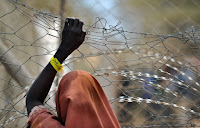
A year ago I was getting ready to go to Malawi and my other blog discusses a few of the complexities of international development that I encountered. Disaster relief efforts, such as the response to the famine in Somalia can be even more complex. For example, it would be simple to imagine a boat load of surplus North American food, perhaps bags of wheat, being shipped to Somalia. But imagine being a farmer near the drought zone seeing his crop value drop as the market is flooded with free imports. Dumping a commodity in Canada would result in a trade dispute, but that dispute mechanism is not easily activated by a rural farmer in east Africa. Hopefully the dollars being directed to help people in Somalia through aid agencies in the developed world will be used to purchase food produced within east Africa so as to stimulate, not crush, their agricultural sector.
Someone recently asked me what I thought was the cause of the famine in Somalia . . . actually ... that isn't true. This person simply stated the cause was too many people. I noted that my great-grandparents lived in a society where big families were the norm and most of the developing world is based upon a similar agricultural economy. My response was perhaps a small education, but it makes me wonder how is it possible for Canadians to get the impression that the famine in Somalia is just an agricultural production problem? It seems to me that the media is explaining there is a long lasting war. But perhaps the difference of circumstance is so far beyond our cultural context that most people are incapable of imagining the situation. I went to a refugee camp when I was in Malawi and I can't truly comprehend what is happening in Somalia.
The Foreign Policy article linked here presents a more complex story of food insecurity routed in political extremism. Just like Stalin starved people to death, so too have extremists conducted a similar campaign in Somalia. Imagine being a logistics officer with Doctors Without Borders and consider what it would be like to negotiate with weapon-toting radicals as you attempt to get food to people who are starving to death. I support a couple organizations that are capable of delivering thoughtful action and I hope you will also give generously -- Doctors Without Borders and CARE
Thursday, April 22, 2010
Apathy & Eco-douchebaggery
There is an article in the May 2010 issue of Explore magazine by J.B. Mackinnon (he wrote the 100 Mile Diet with his wife Alisa Smith) in which he credits the phrase eco-douchebag to conservation scientist Jennifer Jaquet and her Guilty Planet blog where she features an image of a warning sign in a Whole Foods supermarket: "Dear Customer: Please be advised that our Bread Slicer is used for both Organic and Conventional items." What would compel a store to post such a sign? An eco-douchbag agitator and a foolish acquiescence to said sorry sack.
The article ends with: The greatest enemy of change is apathy, and at the heart of apathy Stanley Cohen found denial: "Our need to be innocent of a troubling recognition." Our small and imperfect efforts are constant reminders that there are patterns to break, whole stories to rewrite, and while they are never enough, no, never enough, a little practice surely won't hurt.
----------
Sent from my BlackBerry
Tuesday, January 27, 2009
EWB conference

World leading physicist and Perimeter Institute director Neil Turuk gave the Gala dinner talk about his African Institute for Mathematical Sciences and Jim Balsillie opened Friday by suggesting EWB take advantage of his Centre for International Governance Innovation's IGLOO information sharing platform. Roy Steiner, Deputy Director of the Gates Foundation opened Thursday with a 45 minute talk but stayed an extra day to gather data from EWB's oversea volunteers.
_______________________
Sent from my BlackBerry
Saturday, December 13, 2008
Powerful women
SD = (HC x SP x EE) ** Women
where,
SD = Sustainable Development
HC = Human Condition (basic needs such as shelter, food, clean water, medicine)
SP = Social Position (such as cast or cultural prosecution)
EE = Enabling Environment (everything from climate & weather to agriculture policy, land ownership rights , business start-up complexity , access to investment funds)
This is a very interesting equation presented by Kevin McCort, the CEO at CARE Canada, to help describe the complexity in international development. Note the three factors HC, SP and EE are all interacting functions and the product is then raised to the power of women. A few women will have a small change in development, but a lot will cause an enormous change. And a zero in any factor, no matter how many women are involved will generate no results.
I have heard George Roter, co-founder of Engineers Without Borders comment that if you monitored just one single factor in a society as a proxy for development it would be women's education level. For a society to have more women with more education will require a cascade of things to have occurred which in total will minimize the systemic problems associated with poverty such as access to healthcare, social imbalance, etc - in essence HC, SP & EE.
where,
SD = Sustainable Development
HC = Human Condition (basic needs such as shelter, food, clean water, medicine)
SP = Social Position (such as cast or cultural prosecution)
EE = Enabling Environment (everything from climate & weather to agriculture policy, land ownership rights , business start-up complexity , access to investment funds)
This is a very interesting equation presented by Kevin McCort, the CEO at CARE Canada, to help describe the complexity in international development. Note the three factors HC, SP and EE are all interacting functions and the product is then raised to the power of women. A few women will have a small change in development, but a lot will cause an enormous change. And a zero in any factor, no matter how many women are involved will generate no results.
I have heard George Roter, co-founder of Engineers Without Borders comment that if you monitored just one single factor in a society as a proxy for development it would be women's education level. For a society to have more women with more education will require a cascade of things to have occurred which in total will minimize the systemic problems associated with poverty such as access to healthcare, social imbalance, etc - in essence HC, SP & EE.
Friday, February 15, 2008
Rwanda: education, entertainment and entrepreneurship

At the AAAS conference Rwandan President Paul Kigami stated that Rwanda is working towards allocating 3% of GDP for science and technology, which is a rate equal to South Korea and greater than the U.S. Listen to Kigami and their science & technology minister talk about how they are upgrading their telecommunications infrastructure with goals of fiber to all local counties to facilitate everything from education to entertainment and entrepreneurship.
Subscribe to:
Posts (Atom)